Robotics Papers: A Search Engine for Robot Learning, Built From Reading Clubs
I was in Zurich last week for two robotics meetups. The first was a Robotics Breakfast hosted by Volo Humnytskyi of Robata AI. The second was Dominique Paul's Robot Learning Paper Club, and that one turned into a project.
You can come and listen, and plenty of people do. If you do want the floor, it is ten minutes on your own work or five on a paper you thought was worth the room's time, and people who have presented before get priority when spots run short.
What makes it work is not the format. It is who is in the room. Dominique started the club because robot learning in Zurich was scattered across academia, big tech and startups that were all pushing the field forward and rarely sharing a room. Put a second-year PhD student, an engineer shipping arms to factories and someone switching in from computer vision around the same paper, and the objections come from places none of them would have reached alone. People at different stages of a career, with different backgrounds, learning the thing together.
I had been following Saturday Robotics' club in San Francisco for months and had it filed as a Bay Area habit. Watching the same format run in Zurich, with completely different people, changed my mind about what it was. So I built the index: robotics-papers.gtmascode.dev. Where the clubs meet, what goes on the reading list, who presents, and a six-slide kit for any paper you want to bring.
This continues my side-project series, after a crossword-solving AI, a startup city builder, a wearables brand for humanoid robots, and a satirical SaaS landing page.
Why the format exists
There were 1,159 submissions to arXiv cs.RO last month, up 45% on the same month a year earlier. No individual reads that. A room can cover a slice of it every week and then argue about which part matters, and the argument is the part that does not survive being handed to a summarisation tool. A summary tells you what a paper claims. It cannot tell you that the person two seats over has tried this on real hardware and it did not hold.
What is on the site
Chapters lists eleven groups I could verify are meeting, from a weekly Saturday club in San Francisco to lab seminars that publish their reading lists. They are plotted by longitude, so you can find the room that is awake when you are. Seven cities with serious robotics labs have nothing public at all.
Papers holds 1,192 with dates, topics, venues and citation counts. Thirty-one have been presented at a club, and those carry a ten-minute slide kit pulled from the paper's own sections: the problem, what came before, the method, what was measured, where it breaks, and the line worth remembering. Nothing in a kit is generated. Every sentence is lifted from the paper, which means it can be wrong in the way an extract is wrong, not in the way a summary is.
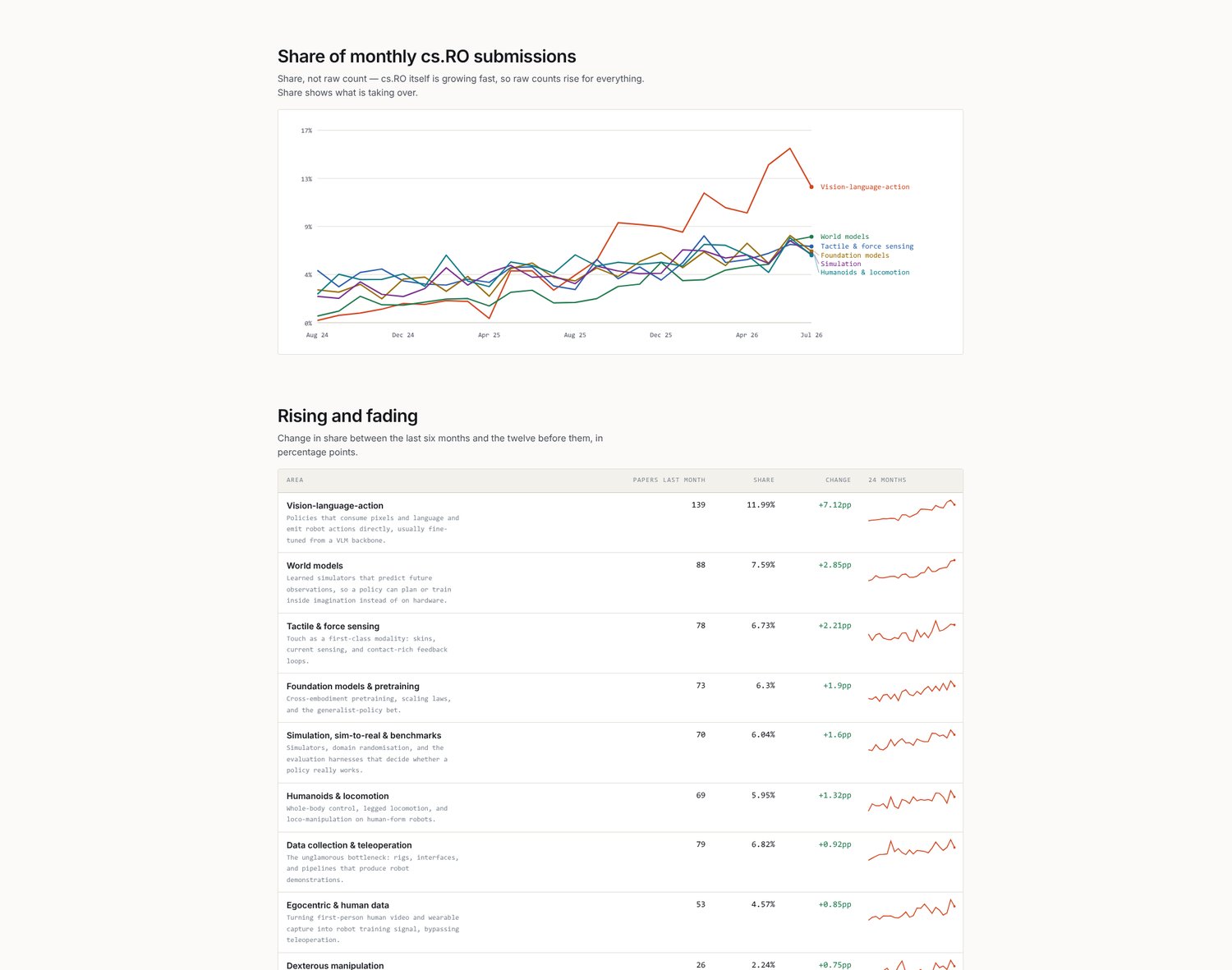
Repos covers 203 projects, because most clubs let you present code instead of a paper and code has to run. Trends tracks how each area's share of cs.RO moves over 24 months, with the arXiv query printed beside every number so you can rerun it. Researchers lists 38 people who have stood up and presented.
What the data said
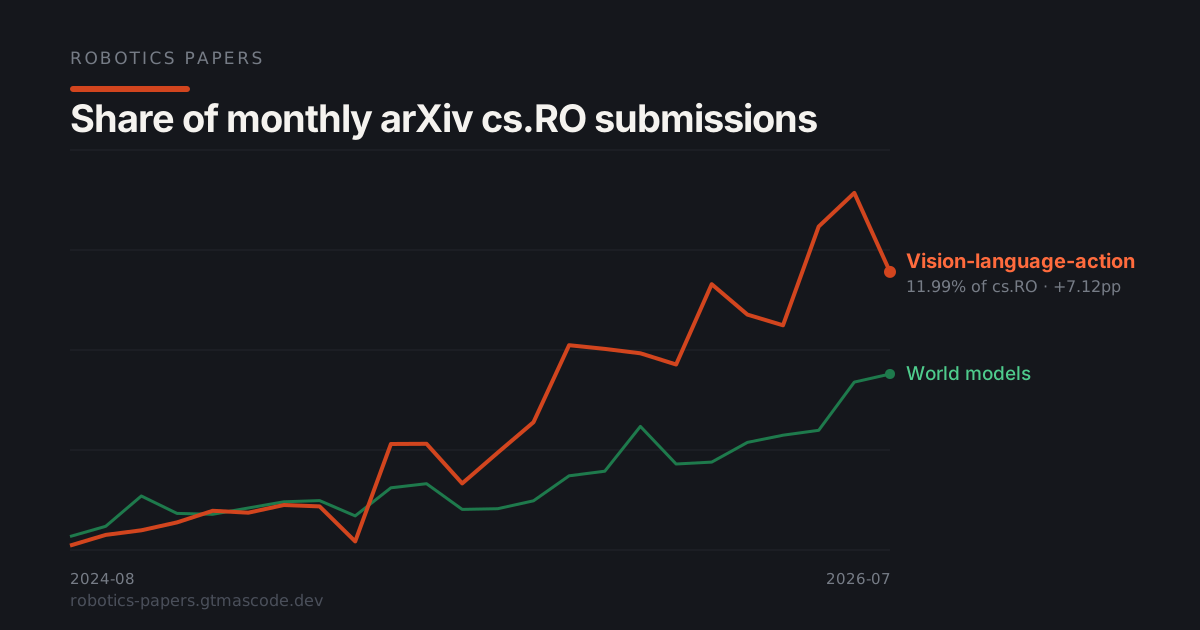
Vision-language-action went from under 1% of monthly cs.RO submissions to 11.99%, a gain of 7.12 percentage points in six months measured against the twelve before. World models added 2.85. Classical navigation and reinforcement learning are both losing share, which does not mean they are shrinking, only that the field around them is growing faster.
The second finding was an accident. I compared 25 reading-list entries against the arXiv record and four used the actual title. An entry billed as "Cross-Embodiment Policy Learning via Representation Alignment" is a paper called "EMMA: Scaling Mobile Manipulation via Egocentric Human Data". Both names are useful in different places, and only one finds the PDF. Resolving every listing back to its arXiv record turned out to be the most valuable thing the site does, and I only noticed the problem because I checked.
The third was more uncomfortable. When I first assembled the data, Zurich came out empty: world-class labs, a quarterly roundtable, no findable paper club. Then I flew there and sat in one that had been running for months. It was on Luma the whole time and I could not surface it. Tel Aviv and Singapore still read as empty on the map, and I have stopped believing that.
The part I got wrong first
arXiv does not disambiguate authors. Searching the computer science categories for one club speaker's name returns 37 papers written by at least two different people, one doing robot learning and one doing code generation. My first pass merged them and would have printed a confident publication count on a real person's page.
The bug was that I linked two papers whenever they shared a co-author, and one shared common surname is enough to connect strangers. Requiring two shared co-authors fixed it, and a count now gets published only when the resulting cluster can be pinned to a paper the person lists on their own site. Eighteen of thirty-eight resolved. The other twenty show a blank cell with an explanation, which is the right trade when the alternative is putting someone else's work under a person's name.
That instinct runs through the rest of the build. Every class of claim gets re-fetched from a source independent of the pipeline that produced it, and the failures are published rather than quietly corrected. The last run passed 64 of 66 checks, and the two that failed are on that page with names attached.
If you want to start one
The guides on the site come from what the existing clubs do rather than from first principles. Fix a slot and publish the next four dates. Write your filter in one sentence: Montreal's group requires a real or simulated robot in every presented paper, which is what stops a robotics club drifting into a general ML club by month four. Give presenters a skeleton so the talk does not become a walk through the figures. Steal Utah's rule, which is to state the paper's three to five core assumptions out loud before showing any results, because in robotics that is where the paper is quietest and where it usually fails.
And spend your effort on the guest list rather than the door policy. One lab talking to itself is a lab meeting. The clubs worth flying to are the ones where the room disagrees with itself.
Browse it at robotics-papers.gtmascode.dev. The datasets are downloadable and agents can query the whole thing over MCP. If your club is missing, put it on the map.
Share this post
Related Posts
Subscribe to the Newsletter
Get the latest insights on vibe coding and marketing delivered to your inbox.