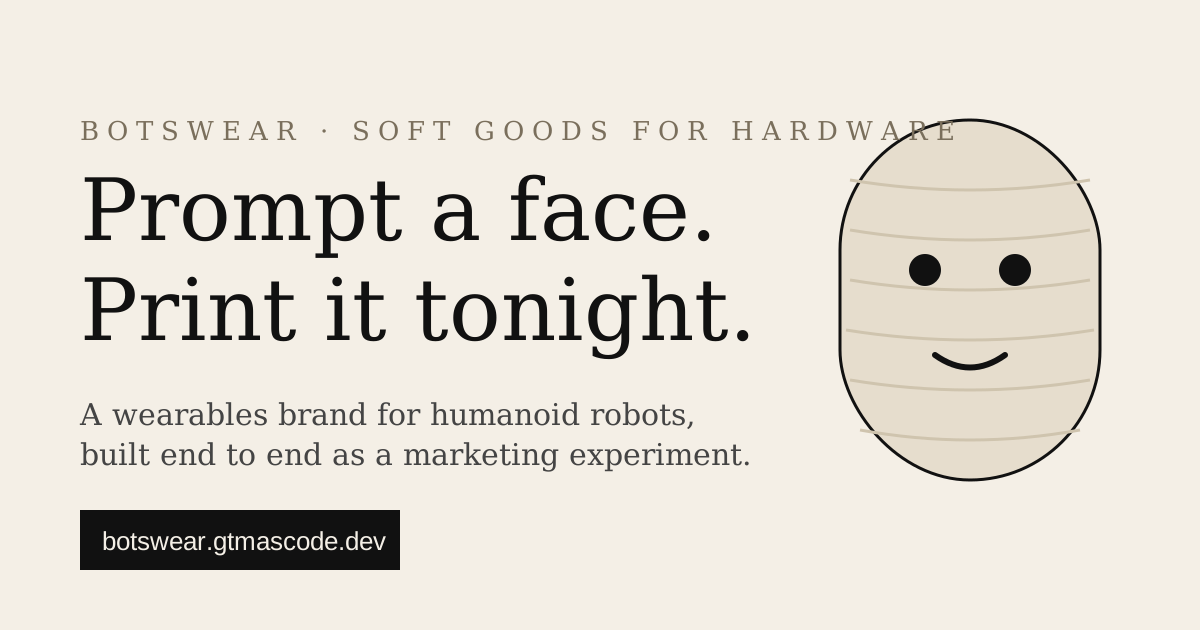
Humanoid robots are about to walk into living rooms, and every one of them has the same problem: the face. Factory faces are glossy voids. Nobody wants to drink morning coffee across from a void. Botswear is my answer, a wearables brand for humanoid robots, live at botswear.gtmascode.dev. The tagline says it all: soft goods for hardware.
It is a speculative brand for a market that barely exists yet. That is exactly why it is useful. With no legacy customers and no competitors, every choice on the site is a pure marketing decision, which makes it the cleanest possible lab for modern marketing mechanics. This continues my side-project series, after a crossword-solving AI and a startup city builder.
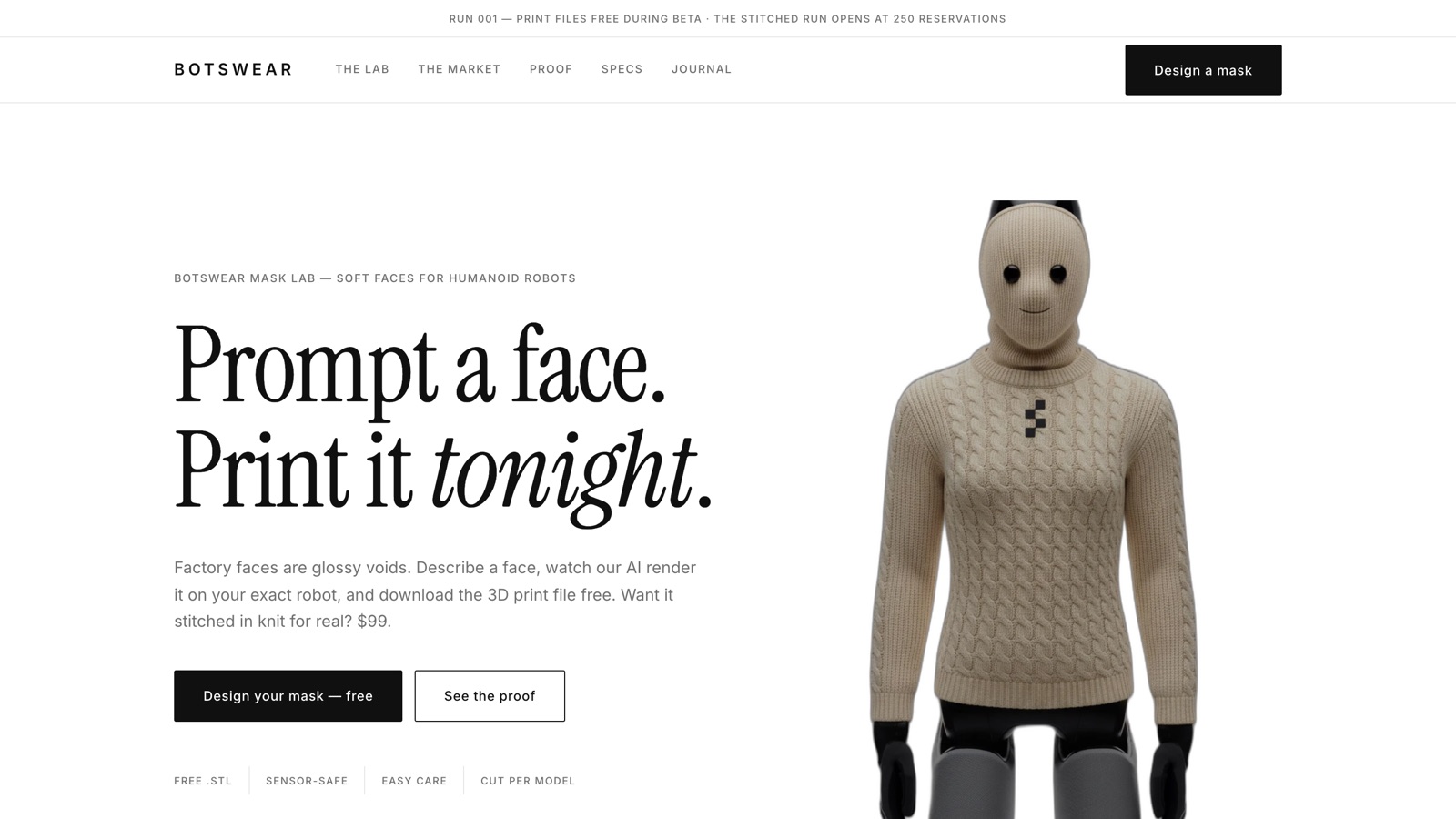
The product: prompt a face, print it tonight
The centerpiece is the Mask Lab, a three-step design flow:
- Choose your robot. The mask is cut per model. No robot yet? Design for the one you are waitlisted for; the file will be ready before the robot is.
- Choose the material. Every option is sensor-transparent, and every card states its care instructions, because a soft goods brand that ignores laundry is not serious.
- Describe the mask. A neural tailor renders your prompt on your exact robot, with two refinement rounds included.
The output ladder is the funnel: the 3D print file is free during beta (parametric OpenSCAD, rendered live in the browser, with eye openings, vents, and strap slots), and the real knitted mask costs $99. Run 001 opens for stitching at 250 reservations, and nobody is charged until it ships.
The marketing mechanics under the knitwear
Strip away the robots and the site is a checklist of go-to-market patterns, each implemented for real:
- Freemium with a physical ceiling. The free .stl file removes all friction, collects exactly one email at download, and makes the $99 stitched mask the natural upgrade rather than a paywall.
- Scarcity that is honest. Run 001 opens at 250 reservations. The number is public, the ticker sits at the top of the page, and the commitment is reversible. Scarcity works best when it is a production constraint, not a countdown timer.
- Community as catalog. Published masks appear in a public gallery for anyone to print and order. Designers get credit and first dibs on collabs, so the customers make the merchandising.
- Content with a point of view. The Journal carries pieces like "Why robots look creepy" and "Should your robot have a face?": top-of-funnel essays that argue the category into existence, which is the actual job of marketing in a pre-market.
What a fake brand proves
Calling Botswear fictional undersells it. The AI render pipeline works, the print files are real, and search engines treat it as a real business: it already collects impressions for robot-face queries at an average position under 7 in Google Search Console. A brand does not need a factory to start compounding distribution; it needs a point of view, a working demo, and pages worth indexing.
The uncomfortable marketing lesson is the same one the robots teach: polish is not warmth. The site works because the knitted mask smiles. If your product page were a face, would anyone want to have coffee with it?
Design one yourself at the Botswear Mask Lab. The print file is free.
Share this post
Related Posts
Subscribe to the Newsletter
Get the latest insights on vibe coding and marketing delivered to your inbox.