AI platforms can increasingly identify where an agentic transaction occurred. They still cannot independently explain what caused the agent to choose.
On June 22, 2026, AppsFlyer announced an unusual financing round.
Moloco, Google, Meta, and Unity, four companies competing for advertising budgets, each acquired a minority stake in the independent measurement company. AppsFlyer did not disclose the financial terms, but Axios reported that the Series E exceeded $1 billion and valued the company at $2.7 billion.
The composition of the investor group matters more than the number.
These companies operate some of the world’s largest advertising platforms. They compete over inventory, targeting, optimization, and ultimately the right to claim that their advertising generated a result. Yet they have collectively invested in an independent company responsible for evaluating those claims.
AppsFlyer stressed that the investors would receive no preferential access to its APIs, measurement signals, attribution logic, or commercial terms. It said the investment would help advance AI-powered measurement, cross-platform attribution, autonomous marketing, and agentic workflows.
The transaction is a signal of where the advertising market is heading.
AI is automating campaign planning, creative production, media buying, product discovery, recommendation, and commerce. As more of the system operates without direct human control, the signals used to evaluate its performance become more consequential.
Marketing agents need to know where to allocate the next dollar. Consumer agents need to determine which products to consider. Commerce agents need to decide which offers to accept. Every automated decision depends on feedback from the previous one.
But the emerging infrastructure still has an unresolved problem.
It can increasingly determine where an agentic transaction occurred. It cannot independently explain what caused the agent to choose.
From attention share to decision share
Digital advertising was built around human attention.
A publisher or platform assembled an audience. An advertiser paid for access to it. The person saw an advertisement, interacted with it, and perhaps completed a purchase.
The simplified journey looked like this:
Impression → click → website visit → conversion
Real customer journeys were never this clean. Buyers encountered television, search results, reviews, email, social media, word of mouth, sales representatives, and offline experiences.
Nevertheless, the digital journey produced enough observable events to support a measurement industry.
An impression established exposure. A click established interaction. A device or customer identifier created continuity. A conversion recorded the outcome. Attribution models then distributed credit across the touchpoints the system could observe.
AI changes the identity of the participant making, or at least shaping, the decision.
A consumer no longer needs to visit ten websites to research a purchase. The consumer can delegate the research to an AI assistant. The assistant can define the category, identify candidates, compare features, inspect reviews, evaluate prices, and produce a recommendation.
As commerce protocols and payment infrastructure mature, the agent can increasingly act on that recommendation.
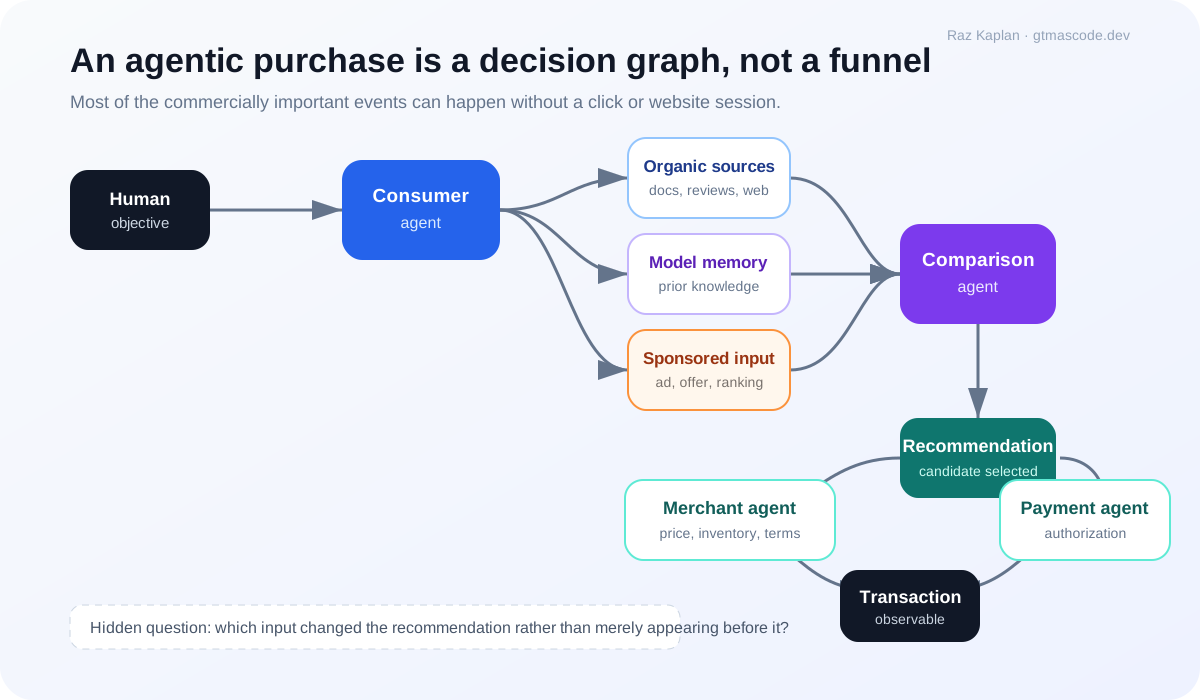
The resulting journey is not simply a longer funnel:
Human objective
    ↓
Consumer agent
    ↓
Category research
    ↓
Source retrieval
    ↓
Candidate generation
    ↓
Product comparison
    ↓
Sponsored intervention
    ↓
Recommendation
    ↓
Merchant interaction
    ↓
Transaction
There may be multiple agents in the process. One may conduct research, another enforce procurement policy, another negotiate with the merchant, and another authorize payment.
The advertiser is therefore no longer competing only for the consumer’s attention. It is competing to enter the agent’s context, pass its eligibility tests, reach its consideration set, and influence its final action.
Marketing is moving from attention share to decision share.
McKinsey describes this as a transition from being seen to being surfaced, recommended, and selected. Its June 2026 research estimates that 10% to 35% of e-commerce transactions could eventually be initiated, influenced, or completed through AI-native experiences.
That shift creates an entirely new marketing stack.
It also exposes the limits of the existing attribution model.
Layer one: Visibility
The first marketing response to generative AI was visibility.
Brands began asking a new set of questions:
- Does ChatGPT mention us?
- Does Gemini understand our product?
- Does Perplexity cite our website?
- Which competitors appear for important category prompts?
- Are AI-generated descriptions of our company accurate?
- Which sources influence those descriptions?
This produced the emerging categories known as answer engine optimization, generative engine optimization, and AI visibility monitoring.
Platforms including Profound, Scrunch, Peec AI, Otterly, Evertune, and others now monitor generated answers across AI systems. They measure brand mentions, citations, sentiment, competitive share of voice, and the prompts for which a company appears.
These platforms solve a real problem. Traditional search analytics cannot explain what happens inside a generated answer. The model may synthesize multiple sources, omit the links it used, or answer the question without sending the user anywhere.
Visibility, however, only measures whether the brand entered the answer.
It does not establish whether the agent could successfully interact with the company.
An assistant might know that a product exists but fail to determine:
- Which version is appropriate
- Whether its information is current
- What it costs
- Whether it is available
- Which claims can be verified
- How to authenticate
- How to request a quote
- How to complete a transaction
Visibility creates an opportunity to participate. It does not complete the journey.
Layer two: Agent experience
The next layer is agent experience.
The distinction is simple:
AEO asks whether an agent can find and describe a company. Agent experience asks whether the agent can successfully use it.
Scrunch’s Agent Experience Platform, following the company’s acquisition by Sitecore in June 2026, detects AI retrieval traffic and serves those agents a parallel, machine-readable version of a website at the CDN layer.
The objective is to reduce technical noise, expose important information without JavaScript dependencies, and present pricing, policies, definitions, and product details in forms that retrieval agents can interpret reliably.
Ora frames agent readiness across five layers:
- Discovery
- Identity and understanding
- Authentication and access
- Agent integration
- Task completion
Its methodology makes the limitation of visibility explicit: appearing in an AI answer is of limited value if the agent later encounters an inaccessible authentication flow, ambiguous product structure, or unusable integration.
Netlify defines Agent Experience as the holistic experience an AI agent has as the user of a product or platform. Snowplow has similarly explored the behavioral infrastructure needed to identify agent traffic and observe the journeys agents take through websites.
This introduces a new optimization discipline.
SEO optimized pages for search rankings. Conversion optimization improved journeys for people. AEO and GEO improved the likelihood of appearing in generated answers.
Agent experience must optimize the entire machine journey:
Discover → understand → authenticate → interact → recover → complete
That requires more than content.
It requires:
- Structured, current product data
- Stable entity and product identifiers
- Explicit capabilities and limitations
- Machine-readable evidence for commercial claims
- APIs and tools for task execution
- Delegated authentication
- Permission and spending controls
- Errors that agents can interpret
- Observability across machine-driven sessions
The website starts to behave less like a digital brochure and more like an API with a human interface attached.
But agent experience only makes the company usable. It still does not explain why the agent selected it.
Layer three: Advertising inside the agent
The agent interface is also becoming advertising inventory.
Kickbacks.ai represents one narrow but revealing experiment. It sells five-second advertising impressions inside the waiting states of developer-controlled Claude Code and Codex interfaces. Advertisers bid for short messages, while the developer whose machine displays the advertisement receives half the revenue.
The format is novel, but the model is familiar. Kickbacks identifies unused human attention and turns it into inventory.
Gravity operates closer to the decision itself.
It provides advertising infrastructure for AI applications, including chatbots, coding assistants, consumer products, and AI-powered search. Its software analyzes the context of a conversation, matches it against advertiser demand, and inserts a relevant sponsored suggestion into the AI experience.
Gravity’s documentation includes auctions, impression tracking, experimentation, and conversion tracking. Its advertising unit is no longer selected primarily from the page a person is viewing. It is selected from the intent expressed inside the conversation.
Scope3 calls the broader category “Sponsored Intelligence.”
In this model, an advertiser is not simply purchasing a rectangle around a piece of content. It is purchasing the opportunity to introduce commercial information into an AI-mediated decision environment.
That may be more valuable than a traditional impression. It is also more difficult to measure and govern.
An agentic interface may contain several forms of influence:
- Information retrieved organically
- Commercial content added to the context
- A sponsored candidate included in a comparison
- A paid ranking advantage
- A dynamically generated offer
- A commercial tool invoked during execution
These interventions do not play identical roles.
A sponsored candidate might enter the shortlist but lose. A discount might change the final ranking. A retrieved review might eliminate the leading competitor. A familiar brand might win because it was already present in the model’s memory.
Each participant may claim influence. The attribution system must determine which claims are meaningful.
Layer four: Agents buying media from agents
AI is also transforming the advertiser side of the market.
Scope3’s Interchange, currently presented as a closed beta, is designed to connect buying, selling, creative, strategy, signal, and governance agents. A brand can provide an objective, budget, audience, and set of constraints. Its agent can then discover inventory, evaluate opportunities, negotiate terms, generate creative, and execute a media purchase.
The underlying open standard is the Ad Context Protocol, or AdCP.
AdCP gives advertising agents a common language for communicating about:
- Media opportunities
- Audiences and signals
- Creative requirements
- Pricing
- Commercial terms
- Brand-safety constraints
- Governance
- Performance goals
- Delivery reporting
AgenticAdvertising.org says the first real agent-to-agent media buy was executed on October 16, 2025 with LG Ads inventory, real money, and human oversight. Because this “first” designation comes from the organization promoting the protocol, it should be understood as the organization’s description rather than independently established history.
The larger structural shift is still important.
Programmatic advertising automated auctions inside a predefined market. Agentic advertising aims to automate the commercial workflow surrounding the auction.
A conventional platform optimizes bids within its own inventory and data model. A buying agent could theoretically compare a connected-TV campaign, retail media placement, podcast sponsorship, AI recommendation, and direct publisher agreement against one business objective.
Planning, negotiation, creative production, buying, optimization, and reporting can begin to operate as one continuous agent workflow.
This could simplify parts of the existing advertising supply chain. It could also strengthen the remaining control points.
Identity, authorization, governance, transaction infrastructure, and independent measurement all become more valuable when agents allocate budgets automatically.
Attribution exists, but only in fragments
It would be inaccurate to say agentic marketing has no attribution.
Several forms already exist.
Shopify’s Agentic Storefronts attach channel or referrer attribution to supported orders. A merchant can see whether a sale originated from an AI channel such as ChatGPT, Copilot, or Gemini.
Gravity provides impression and conversion tracking inside its own advertising network.
Limy markets a system that connects AI visibility and prompt-level activity to traffic, conversions, and revenue.
AI visibility products increasingly measure referrals and downstream business outcomes. Existing attribution companies already provide cross-platform measurement, clean rooms, multi-touch models, marketing-mix modeling, and incrementality testing.
AdCP itself contains important attribution-enabling primitives. It supports conversion-event sources, buyer-attested event delivery, trusted identity matching, log-level signals, and handoffs into clean rooms.
The market therefore does not lack attribution altogether.
It lacks a complete form of attribution for the decision being delegated to the agent.
The distinction is critical:
| Measurement question | Current state |
|---|---|
| Which AI channel referred the customer? | Available |
| Which AI advertisement preceded a conversion? | Available inside some closed networks |
| Which visible prompt or AI interaction preceded a conversion? | Emerging |
| Which sources, advertisements, offers, and agents influenced the decision? | Largely unresolved |
| Did any particular intervention cause the agent to choose differently? | No established neutral standard |
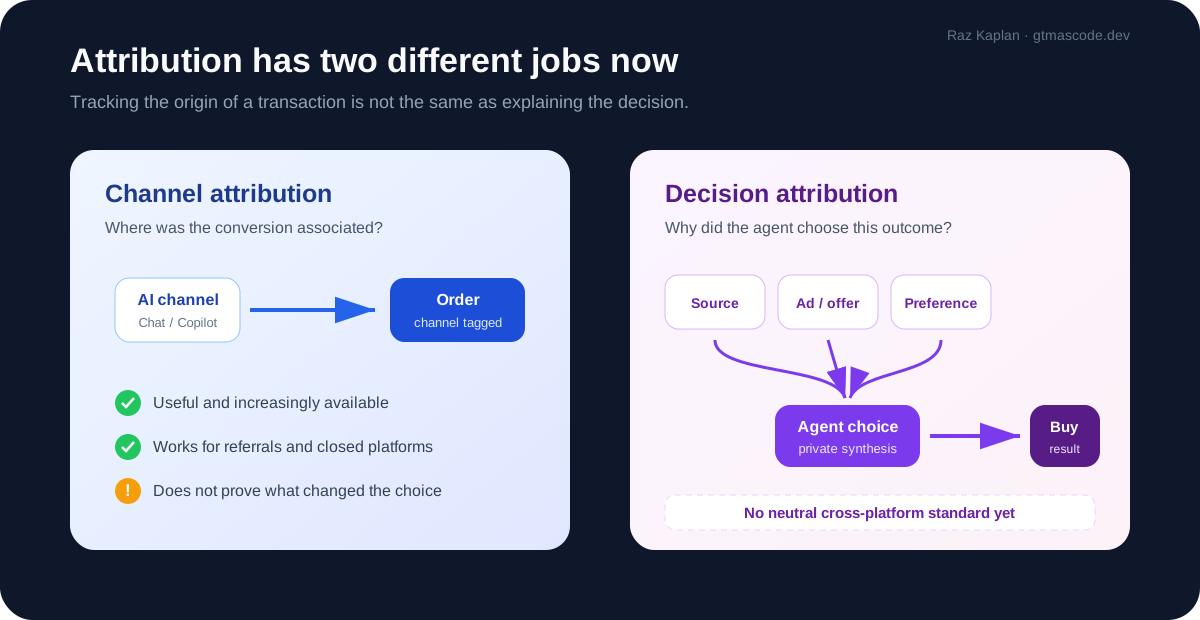
Channel attribution can tell a merchant that an order came through ChatGPT.
It cannot necessarily explain why ChatGPT selected that merchant.
The unit of analysis has changed
Current attribution models attempt to measure a customer journey.
Agentic attribution must measure a delegated decision process.
That is not merely a semantic difference.
In a conventional journey, the central questions are:
Who encountered the message?
What did that person do afterward?
In an agentic journey, the important questions become:
Which information entered the agent’s context?
Which products became eligible?
Which candidates were considered?
Which criteria affected their ranking?
Which commercial intervention changed the result?
Which agent acted, and for whom?
These events may happen inside a private conversation, a model’s latent knowledge, an agent’s memory, or a sequence of tool calls.
None of those surfaces naturally produces the equivalent of a browser clickstream.
The first break: No referral
Search created an observable handoff.
A person saw a result, clicked it, and arrived at a website carrying referral information. The handoff might be incomplete, but it was visible.
An agent can retrieve information without sending a human visitor. It can inspect a product feed, call an API, compare offers, and complete a transaction through a commerce protocol.
There may be no landing page, browser session, cookie, or UTM parameter.
A source can materially influence the outcome without receiving traffic.
This is already one of the central problems in AI search. A publisher’s content may contribute to an answer even when the user never visits the publisher.
Agentic commerce extends the same problem from information to transactions.
A product page may shape a purchase without recording a page view. A review may eliminate a competitor without receiving a click. A structured feed may supply the fact that changes the recommendation.
The influence occurs. The conventional attribution event does not.
The second break: Synthesis
Agents do not simply refer. They synthesize.
Imagine an agent researching accounting software for a small business.
It might use:
- The vendor’s documentation for product capabilities
- A comparison page for pricing
- Reddit for common complaints
- G2 for customer reviews
- A sponsored suggestion for an alternative
- A live offer from the merchant
- The buyer’s private preferences
- Knowledge already contained in the model
The final recommendation may depend on all of these.
Which source deserves credit?
Retrieval logs could establish that the information was accessed. But access does not establish influence, and influence does not establish causality.
AdCP’s measurement framework makes this distinction explicitly:
- Metrics: Did an event happen?
- Verification: Did it count properly?
- Attribution: Did it cause an outcome?
The protocol can help connect delivery data with conversion events. It intentionally leaves attribution models (including clean rooms, media-mix modeling, causal inference, and agentic outcome attribution) outside the protocol.
This is perhaps the clearest evidence of the missing layer.
The advertising transaction can be standardized before its causal interpretation is standardized.
The third break: Privacy
The richest attribution record may exist inside the buyer’s agent.
The agent knows:
- The user’s original request
- The constraints supplied
- The alternatives considered
- The sources retrieved
- The sponsored interventions received
- The offers compared
- The reasons candidates were rejected
- The final recommendation
- Whether the human accepted or overrode it
From a marketer’s perspective, this is an extraordinary dataset.
From the consumer’s perspective, much of it is private.
A request for medical products, financial services, legal assistance, travel, insurance, or employment may reveal information that should never be transmitted to advertisers.
The attribution system therefore needs to prove that a commercial intervention affected a decision without exposing the entire conversation that produced it.
This is a fundamentally different technical problem from placing a tracking pixel.
The fourth break: Multiple agents
An agent does not necessarily act alone.
A consumer assistant might identify products. A specialist shopping agent compares them. A procurement agent checks policy compliance. A merchant agent presents an offer. A payment agent executes the purchase.
The journey becomes a chain of delegated authority:
Person or organization
    → primary agent
        → research agent
        → comparison agent
        → merchant agent
        → payment agent
The system must understand that these interactions belong to the same economic decision.
At the same time, it should not expose more information about the underlying person or organization than necessary.
Traditional identifiers attempt to recognize a user or device. Agentic attribution may need to recognize an authorized decision process.
That requires:
- Agent identity
- Principal identity
- Delegation records
- Permission boundaries
- Cross-agent continuity
- Privacy-preserving matching
A transaction ID can connect the end of the journey. It does not reconstruct everything that influenced it.
The fifth break: Platform conflicts
An AI platform may occupy several positions at once:
- User interface
- Identity provider
- Research agent
- Recommendation engine
- Advertising marketplace
- Merchant gateway
- Checkout provider
- Measurement provider
This creates a closed loop with unprecedented reach.
The platform can determine which information enters the decision, which sponsored interventions are allowed, which products are recommended, which transaction is completed, and how much attribution its own advertising receives.
Its measurement may be extremely precise because it can see the internal journey.
But precision is not neutrality.
A platform can accurately report what happened inside its environment while still using an attribution model that favors its own role.
This is the same structural problem as the advertising walled garden, extended into the reasoning and transaction layers.
McKinsey argues that as data, discovery, transactions, and measurement consolidate inside AI platforms, advertisers may become more dependent on platform-provided reporting. Its research identifies neutral, cross-platform measurement as one of the important defensible positions remaining in ad tech.
That is the broader significance of the AppsFlyer round.
It does not prove that AppsFlyer has solved attribution for consumer-agent decisions. Its current Agentic AI Suite primarily uses AppsFlyer’s existing measurement data to answer questions, identify opportunities, and automate marketing workflows.
What the round validates is more general:
As machines take over more media allocation, independent measurement signals become more economically important.
The sixth break: Attribution becomes executable
Today, an incorrect attribution model generates a misleading dashboard. A human may notice the problem, challenge the methodology, and change the budget.
In autonomous marketing, the attribution result becomes an instruction.
Attribution result
    ↓
Marketing agent
    ↓
Budget allocation
    ↓
New media purchases
    ↓
New conversion data
    ↓
Updated attribution result
This creates a feedback loop.
If a platform consistently overcredits itself, the marketing agent sends it more money. The platform then observes more conversions within its own environment, strengthening its apparent performance and attracting additional budget.
The attribution bias compounds.
Bad attribution is no longer only an analytics problem. It becomes a capital-allocation vulnerability.
The system optimizing the budget needs a reward function. Attribution supplies that reward function.
Whoever controls it exerts substantial influence over where advertising money flows.
What an agentic attribution layer would require
A neutral agentic attribution system would need to combine several technical primitives that currently exist only in fragments.
Decision provenance
Agents need a privacy-preserving way to record commercially relevant events around a decision.
This does not require exposing private chain-of-thought reasoning. It requires recording observable inputs and actions such as:
- Sources retrieved
- Product entities evaluated
- Sponsored information received
- Tools invoked
- Offers requested
- Recommendations produced
- Transactions authorized
These records should be signed and tamper-evident so that platforms, merchants, and advertisers cannot rewrite the journey after learning its outcome.
A new event model
Impressions and clicks are insufficient for a machine decision process.
The ecosystem may need standardized events such as:
- Discovered
- Retrieved
- Parsed
- Qualified
- Considered
- Compared
- Recommended
- Selected
- Negotiated
- Authorized
- Executed
- Rejected
- Overridden
Each event could identify:
- The acting agent
- The represented principal
- The relevant commercial entity
- The source of the information
- Whether the input was sponsored
- The agent’s authority
- The event’s verification status
This would not solve causality, but it would create a common factual record from which causal analysis could begin.
Cross-agent tracing
Attribution metadata must survive handoffs between agents.
A discovery agent may create the initial candidate set. A comparison agent adds evaluation evidence. A merchant agent presents an offer. A payment agent completes the purchase.
The technical model resembles distributed tracing more than web analytics.
In a distributed software system, multiple services contribute spans to a shared trace. Agentic attribution may require a comparable decision trace in which multiple systems contribute signed events under controlled permissions.
Delegation-aware identity
The system must connect agent activity to an authorized principal without exposing unnecessary personal information.
It needs to establish:
- Which agent acted
- Which person or organization authorized it
- What authority it received
- Which specialist agents it delegated to
- Whether the final action remained within policy
Identity here is not simply recognition. It is proof of delegated authority.
Privacy-preserving reconciliation
Advertisers need evidence without receiving the buyer’s private conversation.
Possible technical components include:
- Clean rooms
- Scoped pseudonymous identifiers
- Trusted execution environments
- Cryptographic attestations
- Differential privacy
- Zero-knowledge proofs
- Buyer-controlled event stores
For example, a buyer’s agent might prove that a sponsored candidate entered the final comparison set without revealing the other candidates or the original prompt.
The objective is selective accountability: enough evidence to evaluate an attribution claim, but not enough information to reconstruct the user’s private intent.
Independent measurement
No single participant naturally sees the full decision graph.
The agent platform observes the conversation. The advertiser observes media delivery. The merchant observes the transaction. The buyer owns the outcome. The payment provider verifies settlement.
A neutral measurement layer would need to reconcile:
- Platform-reported exposure
- Agent-side decision events
- Merchant-side transactions
- Buyer-side business outcomes
This is a network problem, not simply an analytics dashboard.
Incrementality
Even perfect provenance does not establish causality.
Knowing that an advertisement entered an agent’s context does not prove that it changed the recommendation. The agent may have selected the same product without it.
Agentic attribution therefore still requires experimentation:
- Holdout groups
- Ghost advertisements
- Randomized sponsored eligibility
- Counterfactual recommendation sets
- Geographic tests
- Budget discontinuities
- Media-mix modeling
- Causal inference
Agents could potentially make these experiments more systematic.
A buying agent could automatically reserve control populations. A recommendation system could record the result it would have produced without a sponsored input. A measurement provider could compare the actual decision with a counterfactual policy.
But the entity selling the influence should not be solely responsible for defining the counterfactual. Otherwise, the system reproduces the platform conflict in a more sophisticated form.
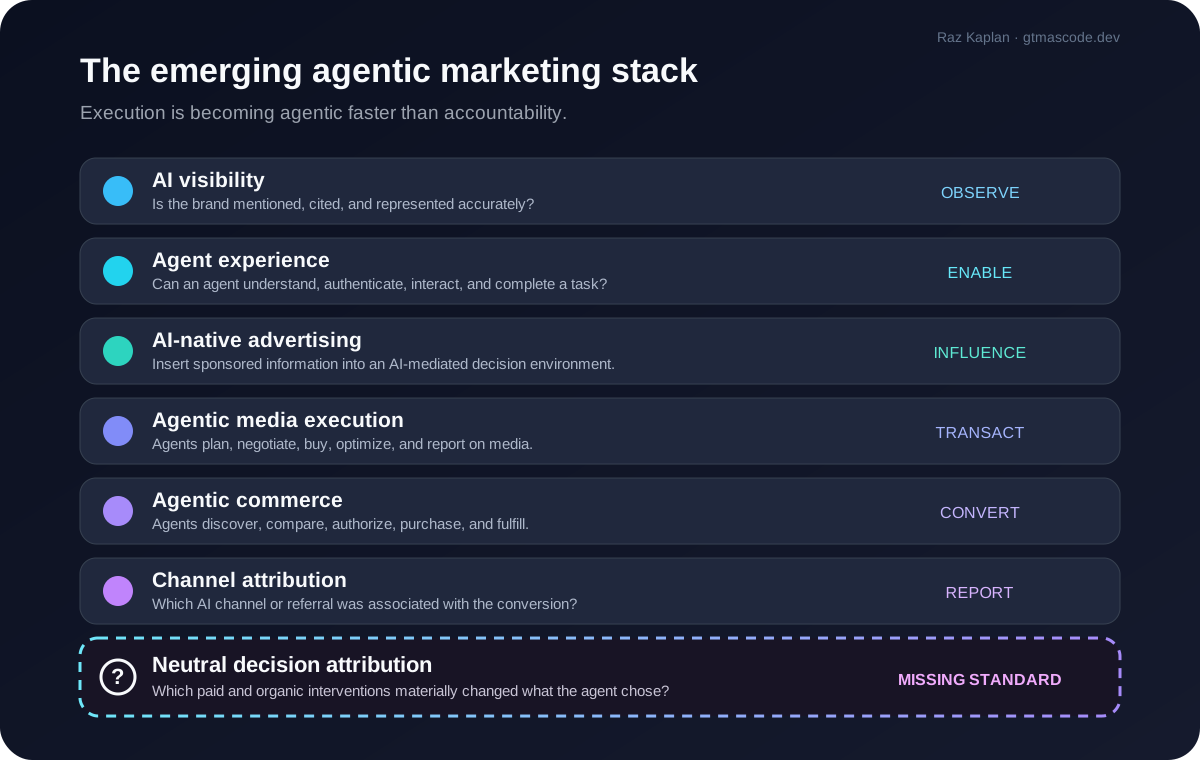
The emerging agentic marketing stack
The market is beginning to divide into distinct layers:
| Layer | Primary function | Examples |
|---|---|---|
| AI visibility | Measure whether a brand is mentioned, cited, and represented accurately | Profound, Peec AI, Otterly, Evertune |
| Agent experience | Make brands and products understandable and actionable to agents | Scrunch/Sitecore, Ora, Netlify |
| AI-native advertising | Insert sponsored information into AI experiences | Gravity, Kickbacks, Sponsored Intelligence |
| Agentic media execution | Allow agents to plan, negotiate, and purchase advertising | Scope3 Interchange, AdCP |
| Agentic commerce | Allow agents to discover products and complete transactions | Shopify Agentic Storefronts and commerce protocols |
| Channel attribution | Identify the AI platform or referral associated with a conversion | Shopify, Limy, Gravity, existing analytics providers |
| Decision attribution | Determine which interventions caused the agent to select a particular outcome | No established neutral standard |
The final row is the missing layer.
It is not missing because nobody offers AI-related attribution. Several companies do.
It is missing because today’s solutions generally measure one of three narrower objects:
- The referring AI channel
- A visible prompt or referral
- An advertisement and conversion inside one controlled environment
They do not yet provide a neutral, interoperable account of how paid and organic inputs influenced a private, multi-agent decision.
Where value may accrue
As agentic marketing develops, several strategic control points become visible.
The agent interface owns intent
The interface knows what the customer is trying to accomplish before most commercial systems do.
The agent-experience layer owns legibility
It determines whether products, policies, and capabilities can be interpreted and acted upon reliably.
The advertising layer owns paid intervention
It controls when and how commercial information enters the decision environment.
The commerce layer owns execution
It connects recommendation to inventory, pricing, checkout, and fulfillment.
The identity layer owns authority
It determines which agent may act, for whom, and under which constraints.
The attribution layer owns the reward function
It determines which intervention receives credit and where the next marketing dollar goes.
That final role may be the most strategically important.
Measurement does not simply describe an advertising market. It directs the market’s capital.
Once marketing agents allocate budgets autonomously, the attribution provider becomes part of the system’s control plane.
The next measurement company
The first generation of digital attribution asked:
Which click produced the conversion?
Multi-touch attribution asked:
Which observable interactions contributed to the customer journey?
Agentic attribution must ask:
Which information and commercial interventions materially changed a delegated decision?
That question cannot be answered by referral data alone.
It requires decision provenance, cross-agent tracing, delegated identity, privacy-preserving reconciliation, independent measurement, and causal experimentation.
Most of the necessary components exist somewhere in the emerging ecosystem. None has yet become the neutral, cross-platform standard for attributing machine-mediated decisions.
That is the real significance of the current market.
Scrunch and Ora are helping companies become legible to agents. Gravity and Kickbacks are exploring new advertising surfaces. Scope3 and AdCP are building infrastructure for agent-to-agent media transactions. Shopify is connecting AI channels to commerce and reporting their resulting orders. Limy and others are beginning to connect AI discovery with revenue. AppsFlyer is positioning independent measurement as infrastructure for autonomous marketing.
The execution layers are converging.
The accountability layer is not.
The next major measurement company may not merely tell a marketer where a sale came from. It may provide a trusted record of why an agent selected one commercial outcome over another, and whether a paid intervention actually changed that result.
Because in an economy where agents increasingly decide what to recommend, buy, and fund, the most important question in marketing remains the oldest one:
Who deserves the credit?
Share this post
Related Posts
Subscribe to the Newsletter
Get the latest insights on vibe coding and marketing delivered to your inbox.